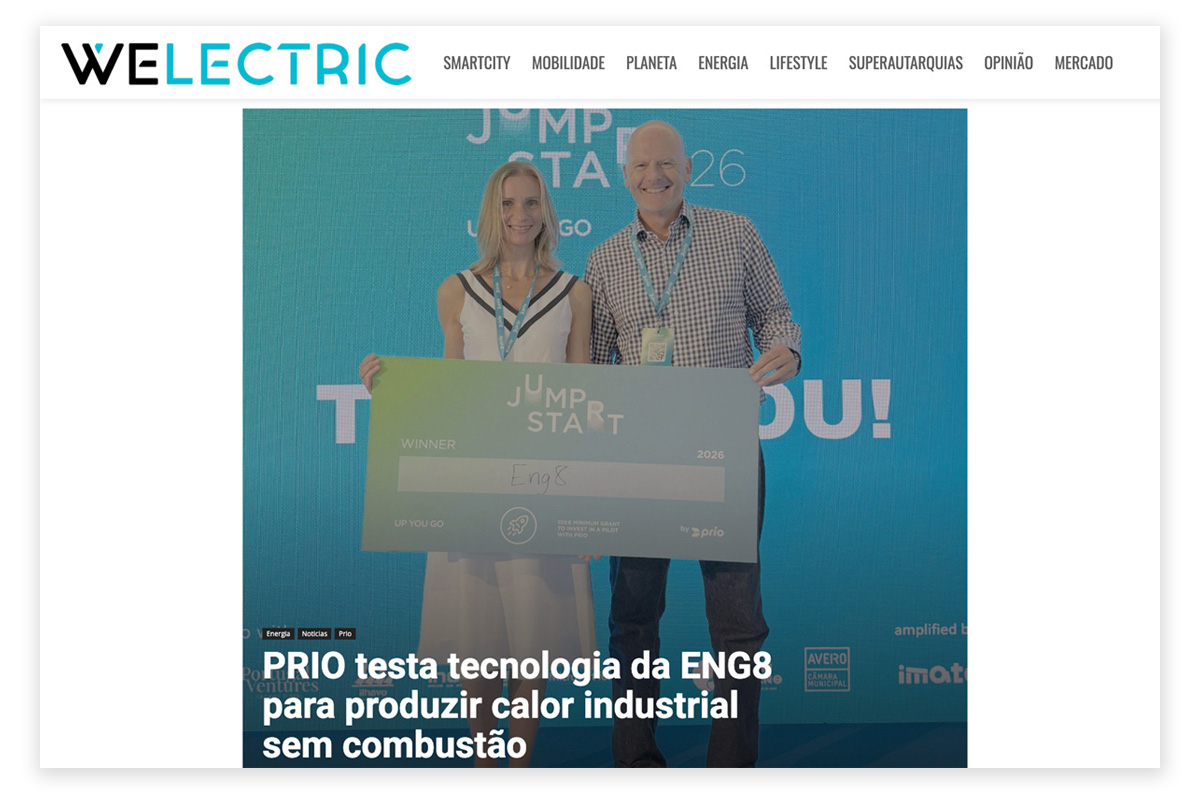
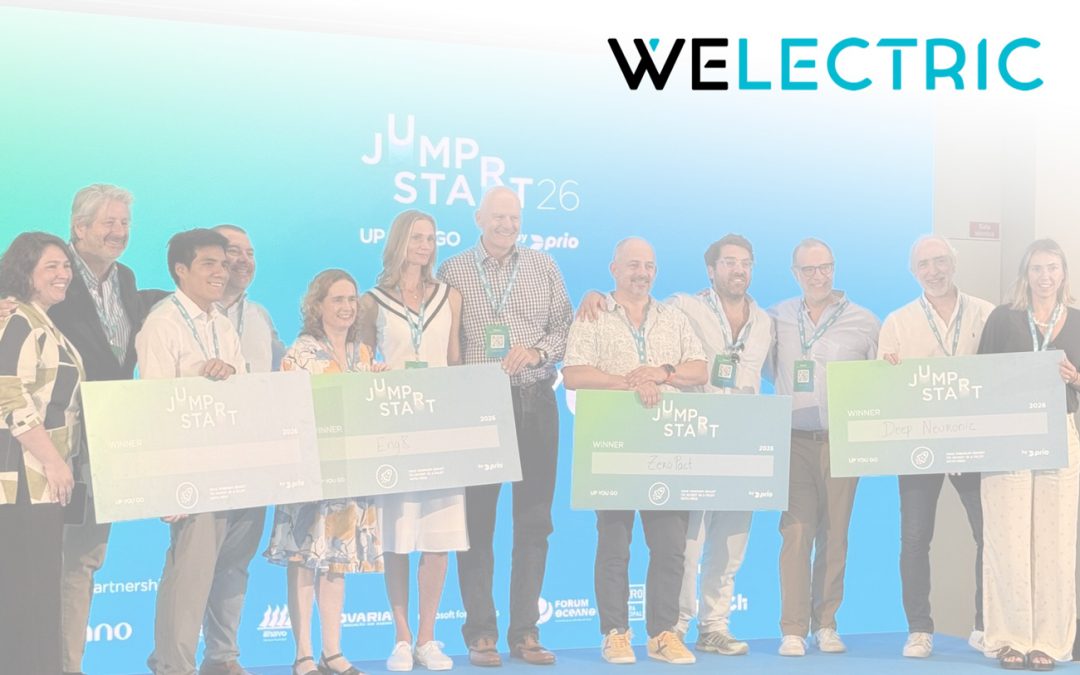
Following ENG8’s selection as one of the winners of PRIO’s JumpStart 2026 open innovation programme, Portuguese energy publication Welectric interviewed our founders, Valeria Tyutina and Haslen Back, about the technology, the significance of the award and the industrial pilot now being developed with PRIO.
The interview explores how the EnergiCell® is moving from laboratory validation into real-world industrial applications, the opportunities for decarbonising process heat and why Portugal is an important market for ENG8’s first commercial deployments.
The interview was originally published in Portuguese on 30 July 2026. Below is an English translation of the original article.
In a nutshell, what is the problem your company seeks to solve?
Industry needs energy that is clean and cheap. Today it has to choose. Firming renewables to run 24/7 costs somewhere around €4–8m per megawatt and still takes years to build; new fission runs to €10–20m per megawatt, and fusion is expected to cost more. Meanwhile a ceramics plant or a refinery burns gas because nothing else delivers heat at the temperature, the reliability and the price it needs.
We make heat and power that undercuts gas from the first day, with no combustion and no emissions of concern, in a unit the size of a shipping container that we can install in days. The customer buys the energy, not the machine. That is the model we are now proving in Portugal with Prio.
1. How did the idea come about, and when was the project born?
The science is older than the company. Low-energy nuclear reactions have been studied for decades, and ENG8 was built by bringing together three separate LENR research teams—around 35 scientists and engineers—who had each spent years on the problem in isolation. Our founders, Haslen Back and Valeria Tyutina, backed that consolidation through their technology investment and commercialisation business, putting in roughly €7m and eight years of their own time.
What changed was not the physics but the engineering. The work moved from asking whether the effect is real to asking whether it can be made to run reliably, in a box, on a factory floor.
2. What stage is the technology at? Is it on the market or still in validation?
Neither, precisely—we are at the point where they meet. The reaction itself has been independently validated more than once: two major laboratories, including a coefficient of performance of 5 measured at Culham; three separate validations carried out in Portugal by the Instituto Electrotécnico Português in Porto; and self-powering work verified by Professor Jean-Paul Biberian. Our labs measure a COP of 7 to 10, meaning seven to ten times more energy out than the electricity we put in.
What has not happened yet is a customer’s production line. That is what the Primus trial is: a 100 kW unit moving the technology from TRL 4–5 to 7–8, in plain terms, from a technology validated in the laboratory to one proven on a working site, under real industrial load. First commercial energy sales are planned for Q4 2026.
3. What distinguishes your solution from existing alternatives?
Three things:
Cost: roughly €500,000 per megawatt to build, against €4–8m for firmed renewables and €10–20m for fission.
Speed: the components are largely off-the-shelf with a 90-day lead time, so we build in days rather than years, and we are not waiting on grid connection.
Independence: the reaction is fuelled by the hydrogen and oxygen in water. There is no fuel supply to secure, no radioactive material, no rare-earth or toxic metals, and no harmful radiation has been detected above background.
The honest comparison is not with another generator. It is with the gas bill a factory already pays.
4. What impact do you expect in sustainability, energy efficiency and emissions?
On the Prio boiler alone, replacing methane removes around 14,200 tonnes of CO₂ a year, roughly the annual emissions of 8,000 combustion-engine cars—about 142,000 tonnes over a ten-year contract—along with roughly 11 tonnes of NOₓ, 9 tonnes of carbon monoxide and 0.8 tonnes of particulates, because there is no combustion at all.
Scale that thought. Portugal’s entire industrial heat demand is roughly 3.4 GW. Industrial heat is one of the hardest parts of the economy to decarbonise precisely because electrification is expensive and hydrogen is scarce. We are low-carbon today, running on grid electricity (which in Portugal is already majority-renewable), and near-zero from 2027 once the generator powers its own reaction.
For the Portuguese economy and its citizens, we see five benefits.
Cheaper energy. Industry saves around 20% from day one, and our cost curve points to off-grid electricity for consumers at roughly €50/MWh within a decade, a fraction of what Portuguese households and businesses pay today.
Competitiveness and jobs. Energy is one of the largest cost lines for ceramics, glass, food and paper. Cutting it keeps energy-intensive industry, and the jobs that go with it, in Portugal.
Energy independence. The reaction is fuelled by the hydrogen and oxygen in water, so there is no imported gas, no fuel-price shocks and no supply lines to secure, saving Portugal billions of imported hydrocarbons annually.
Faster decarbonisation. With no combustion, the emissions are never created, helping Portugal meet its climate targets without asking industry or households to pay a premium.
Leadership. The technology was validated in Porto and will be proven in Aveiro. If the pilot performs, Portugal becomes the launchpad for a new energy industry, with the investment, skills and exports that follow.
5. Why did you decide to apply for PRIO Jump Start?
Because a technology like ours does not get adopted on the strength of laboratory data. It gets adopted when a serious industrial operator puts it on their own site and lets it carry real load.
Prio, one of Portugal’s leading fuel and energy companies, offered exactly that: a working 8 MW gas boiler at its biodiesel refinery in Aveiro, an operator with the engineering depth to judge the results honestly, and a route to market. Prio sells energy. We supply it. If the pilot performs, the model repeats across their customer base rather than one plant at a time.
6. What does it mean to have been one of the winning startups of this edition?
Most of the companies in the programme were established scale-ups with proven technologies, so the award is a form of commercial, real-world validation we could not have manufactured ourselves. It puts our equipment on the site of one of Portugal’s most significant energy companies and funds the pilot that does it.
It also arrived in the same week as a signed letter of intent from Primus Ceramics and a letter of support from APICER, the Portuguese ceramics association, whose 1,281 member companies turn over €1.6bn between them. Taken together, that is a sector telling us the problem is real and they want it solved.
7. What will the pilot with PRIO consist of, and what do you expect to demonstrate?
A 100 kW EnergiCell will feed closed-circuit hot air into Prio’s existing fire-tube boiler, replacing the methane burner. The boiler stays; the steam specification stays; only the heat source changes. From there we stage up -one megawatt, then the full eight.
What we expect to demonstrate is unglamorous and exactly the point: that the unit runs continuously under industrial load, holds 10-bar steam, and delivers heat at roughly €35.95 per MWh against the €44.94 Prio pays today. Around 20% cheaper, with the price fixed for a decade while gas and carbon costs keep climbing.
8. If the pilot succeeds, what future applications could the technology have?
AIndustrial heat is the beachhead, not the destination. Once the generator powers its own reaction, the constraint of a grid connection disappears, and the whole off-grid picture opens: electricity anywhere, without a cable.
Beyond that we see transport—hybrid electric vehicles and charging infrastructure, and vessels, where marine fuel rules are tightening fast—and eventually licensing EnergiCells to manufacturers to build into vehicles, machinery and appliances. For electric mobility the implication is direct: a charging hub that needs no grid connection can be installed wherever drivers need it, motorway services, ports, rural districts, without waiting years for a network upgrade. A generator that needs no fuel and no grid is a different kind of component from anything they can specify today. Because the EnergiCell produces electricity as well as heat, the same technology can in the very near future power cars, EV chargers, e-trucks, vessels, ports and islands, and our cost curve points to off-grid electricity for consumers at around €50/MWh within a decade. Clean, abundant energy for all is the destination.
9. Where would you like to be in five years?
At gigawatt scale, and boring.
The supply chain is already automotive-grade and largely off-the-shelf, so what paces us is not manufacturing but installation and commissioning—which is precisely what investment accelerates. We expect around 100 MW installed within two to three years and gigawatt-scale within three to five.
The real ambition is that clean, cheap, firm energy stops being a subject of debate and becomes something a factory manager simply orders.
10. Your technology promises heat, steam, electricity and hydrogen. How does the process work, simply?
Water goes in. An electric field splits it into hydrogen and oxygen ions. Those ions are drawn together into dense, condensed structures called plasmoids, and within them a low-energy nuclear reaction releases energy—as heat and as electricity.
Because that energy comes out as very high-grade heat, we can present it in whichever form the customer’s process needs: hot air up to around 1,250°C, steam at pressure, electricity, or hydrogen through plasma electrolysis.
One distinction matters. A heat pump also quotes a COP, but it only moves heat that already exists. The EnergiCell releases new energy, and can run on its own output. That is the difference between an efficiency gain and a genuine energy source.
11. Which industrial sectors can it be applied to?
Any sector where high-temperature process heat is a major cost line. Ceramics first—that is Primus—then glass, food, paper, cement, steel and refining, which is Prio.
Our first two customers were chosen deliberately: a furnace at around 1,000°C and a steam boiler at 10 bar are two of the hardest, most common industrial heat duties there are. Solve those and most of the rest of industry is a variation on them. Beyond heat, we are already in conversation about controlled-environment horticulture in the Netherlands.
12. What is the main advantage over conventional solutions?
The customer saves money on day one. Nothing else about a decarbonisation project is as persuasive as that.
Every other clean option asks industry to pay a premium now for an environmental benefit later. We deliver energy at roughly 20% below what the customer currently pays for fuel, carbon and losses combined, and we fix that price for the length of the contract. The carbon reduction comes as a consequence, not as a sacrifice.
13. What energy efficiency gains can you achieve?
Independently validated at a COP of 7 to 10—seven to ten times more energy out than the electricity we put in.
That figure is why the economics work. It is also why the technology powers itself: once the coefficient is high enough to cover real-world losses and still leave a surplus, the generator no longer needs the grid. We have demonstrated self-powering on a smaller laboratory reactor, running for 160 minutes in October 2025. Engineering it into the 100 kW generator is targeted for 2027.
14. How does the technology contribute to reducing CO₂ emissions?
By removing the combustion, not by offsetting it. There is no flame and no flue gas, so the emissions do not need capturing—they are never created.
Today the units draw start-up power from the grid, which makes them low-carbon rather than zero. From 2027, when the generator powers its own reaction, the energy becomes near-zero carbon. We also expect to certify avoidance carbon credits under the VCS standard, which adds a second revenue layer on top of the energy sales.
15. What are the main challenges in bringing this technology to market today?
Three, in order of honesty.
Engineering. Self-powering works on a laboratory reactor; getting it into a 100 kW generator in the field is a 2027 target, not a solved problem.
Capacity. The components are commercially available with a 90-day lead time, so the bottleneck is not supply—it is how fast we can install and commission. That is a funding question more than a technical one.
Credibility. This field has a difficult history, and we are aware of it. Our answer is not to argue. It is independent validation, repeated by different agencies, and now a unit running on somebody else’s production line, measured against their own gas bill.
See the article on Welectric: