

This summer, extreme heat has hit the United States hard. The recent Western heat dome pushed temperatures up to four degrees above previous records – “extremely hard to do statistically,” as EPRI climate data analyst Erik Smith put it to Energy Central. Records like that, he added, are only going to become more common.
Europe has had its own version of the same story. On 23 June 2026, France recorded its hottest day since national records began, with parts of the country topping 44°C. The heat forced operators to take three nuclear reactors offline, Golfech, Bugey and Chooz, because the rivers that cool them, the Garonne, the Rhône and the Meuse, had grown too warm to safely absorb the discharge water. Around 70,000 French households lost power on the day. Because Germany and the UK both import French nuclear electricity, the shortfall did not stay inside French borders.
Different continents, the same underlying fault: a power system built for a stable climate is being asked to run through an unstable one.
A system stretched from every direction
Heat does not attack the grid at a single point. It leans on nearly every asset at once, and each type of generation has its own breaking point.
- Nuclear plants are, in Smith’s words, “very risk-averse.” They depend on nearby rivers, lakes or the sea to cool reactors and take the discharge water. High river temperatures throw off that balance, which is exactly what happened in France this summer, and has previously forced French plants to cut output to avoid sending hot water into already hot rivers.
- Solar generation, counterintuitively, suffers on the hottest days. PV panels are built to perform best around 25°C. Above that, output drops by roughly 0.5% for every additional degree – so the sunniest, hottest afternoons are often when panels are least efficient.
- Battery storage loses capacity in extreme heat. Lithium-ion batteries operate best between about 15°C and 35°C; beyond that range, storage capacity declines, and the air conditioning used to protect the cells draws down the very output they are meant to preserve.
- Transmission and distribution infrastructure ages faster under sustained heat: conductor capacity falls, transformer insulation degrades, and underground cables corrode more quickly.
Forecasting is the one lever that helps across the board, accurate, ample weather data lets operators prepare before demand spikes. That makes it a concern that, in the US, National Weather Service staffing cuts have reduced the launches of the weather balloons operators rely on. A strong El Niño this year cuts both ways: more searingly hot days, but also – because El Niño patterns are comparatively predictable – more lead time to prepare for them.
The economics are catching up too
The strain shows up in market outcomes as well as physical ones. PJM Interconnection is the regional transmission organisation that coordinates wholesale electricity across 13 US states and Washington DC – the largest single grid in the country, covering roughly 65 million people. Its 2028–29 capacity auction, which sets the price generators are paid to guarantee future supply, secured over 138 GW of capacity but still fell 7 GW short of PJM’s own reliability requirement, the third straight year of shortfall. The auction hit its FERC-approved price cap of $325/MW-day for the second year running. PJM’s chief operating officer, Stu Bresler, said plainly that demand for electricity is now growing faster than new generation is being built. Data centres were the single biggest driver: they contributed over a third of the auction’s $16.4 billion total capacity cost, and have added nearly $30 billion in such costs since 2024.
Europe faces a version of the same squeeze. Industrial energy users across Portugal and Spain are exposed to gas prices that have climbed and stayed volatile since 2022, and the EU’s Clean Industrial Deal, built around cutting emissions by at least 55% by 2030, is pushing energy-intensive industries toward electrification and alternative heat sources faster than most supply chains can currently deliver them.
Why this keeps happening
Two trends are colliding. Demand is climbing, driven by data centres, industrial electrification and population growth. At the same time, a warming climate is making the plants meant to meet that demand less reliable exactly when they are needed most. Firming up renewables, building new fission capacity, or waiting for fusion are the paths most commonly discussed, and all three are, at minimum, years away and constrained by how much new grid capacity can physically be built in that time.
A generator that doesn’t share the same weak points
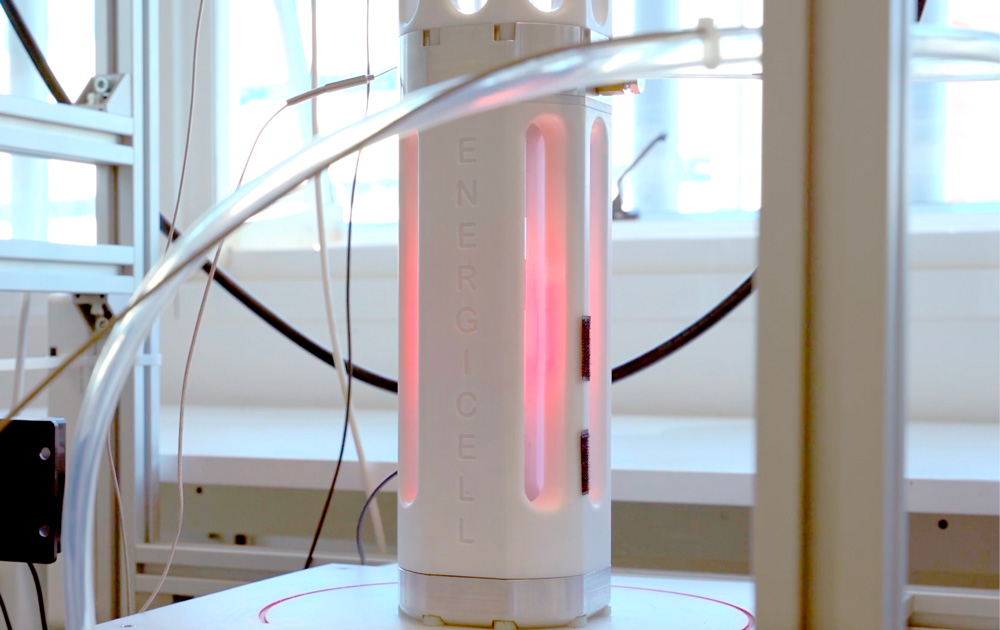
ENG8 has been developing a different answer: the EnergiCell®, a patented low-energy nuclear reaction (LENR) technology that produces thermal and electrical energy from the hydrogen and oxygen in water. It carries no radioactive material, no harmful radiation above background levels, and no rare-earth or toxic metals. The technology has been independently validated multiple times, including coefficient-of-performance tests at Culham, Instituto Electrotécnico Português, and by Professor Jean-Paul Biberian.
The design choices map directly onto the failure points above, though it is worth being precise about what is proven and what is still being demonstrated at industrial scale. EnergiCells are engineered to run without river, lake or sea water for cooling, so they are designed to carry none of the discharge-temperature risk that took French reactors offline this summer. They do not rely on lithium-ion chemistry, so they are not exposed to the storage-capacity losses batteries suffer in extreme heat. And because units are modular 100 kW generators intended to scale to megawatt-plus deployments and designed to be installed directly on a customer’s site in days rather than years, they are built to avoid the long transmission runs where much of the heat-driven grid degradation occurs in the first place. These are the engineering targets the current trials are set up to test in a live industrial environment, not yet a multi-year operating track record.
EnergiCells are designed to be sold as energy-as-a-service, with ENG8 owning and operating the generators while the customer buys the energy delivered – targeted below their current total energy cost from day one and fixed for the long term while gas and carbon costs keep climbing. The underlying technology has been validated in the lab; the current phase of work is proving it as an industrial generator.
Moving from lab to industrial trials
ENG8 is not yet an operating energy supplier; it is in the process of becoming one. A 100 kW EnergiCell is currently under test at ENG8’s own facility, and under a letter of intent signed with Primus on 29 June 2026, that unit is being prepared to move onto a live ceramics production line in Aveiro, Portugal, to trial roughly 1,200°C hot air in place of gas. The trial is scheduled to begin this quarter and, if it performs as expected, is intended to lead to a ten-year, 20+ MW heat power purchase agreement. The trial has the backing of APICER, Portugal’s ceramics association, which represents 1,281 firms and €1.6 billion in industry turnover.
A second trial follows ENG8’s selection for Prio’s 2026 JumpStart programme, chosen from ten finalists. The proposal is to trial an EnergiCell generating hot air in place of methane at Prio’s biodiesel refinery, with a view to a larger-scale repower of the site’s existing gas-fired boiler if the pilot succeeds. Scope, timing and commercial terms are still being finalised with Prio and have not yet been agreed, so are not detailed here.
Both trials sit inside a substantial regional opportunity: industrial heat demand in Portugal alone is estimated at €2–3 billion a year, rising to €9–12 billion a year across the wider Iberian market via Spain, where DISA could in principle supply all of Portugal’s industrial heat load. Realising that opportunity depends on these first trials succeeding and on ENG8 scaling its assembly, installation and commissioning capacity beyond the pilot stage. From there, ENG8’s longer-term roadmap extends to the wider off-grid opportunity, electricity generation, transport, and licensing EnergiCells into vehicles, vessels and machinery.
What this means for the grid
Heat waves will keep testing the grid as long as the grid’s generation depends on stable rivers, mild air temperatures and long transmission corridors to function. Nothing about that dependency is going away on its own; the EPRI view is that record-breaking heat events will simply become more frequent. What can change is how much of the system relies on conditions it cannot control.
A generator that makes its own power from water, sits on the customer’s site, and is designed to run the same way at 20°C or 44°C would not be a like-for-like replacement for the whole grid. ENG8 is not there yet: the EnergiCell is moving from validated lab results into its first industrial trials in Portugal, with energy sales targeted from the fourth quarter of 2026. For the industrial heat loads currently burning gas, and exposed to the same price and reliability risk as the wider grid around them, it is a technology to watch closely as those trials report back.